Square Halts Verified Small Business Account Without Giving Any Reason
A digital payments giant suspended a fully verified marketing firm, ignored its own appeal deadlines, and relied on contract terms that allow it to withhold funds indefinitely without explanation.
By Lorenzo Evans ·
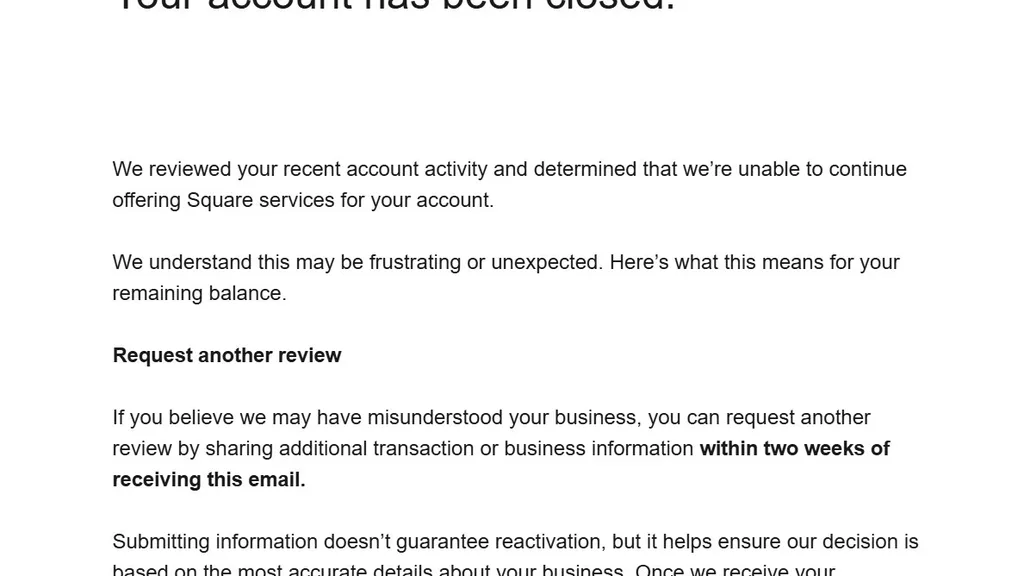
A small marketing and search engine optimization firm recently found itself caught in a bureaucratic trap that left its owners feeling powerless. The business operates online and helps other companies improve their digital presence. It had followed every step required to set up its account with Square, a popular American payment processing company. The owners submitted government identification documents. They linked a valid bank account using third-party software. They provided the Employer Identification Number, or EIN, directly from the Internal Revenue Service. They uploaded the documents that formed their Limited Liability Company, or LLC. They even held a signed contract with a client for the full amount of money in dispute. Despite this thorough verification, Square suspended the account.
The suspension was not the result of a missing document or a failed bank verification. The IRS did not flag the tax number as fake. Instead, the company pointed to a rule that the business owners argued did not even exist in the official list of reasons for suspension. The machine had made its decision, and the system did not accept questions. The business appealed, as is standard procedure. Square promised a response within ten days. The actual response arrived two weeks later. It was a denial. There was no explanation. There was no reason provided. There was no human being to call and no office to visit. There was only a digital denial from an automated system.
This incident highlights a significant tension between small businesses and the platforms that process their money. For many entrepreneurs, Square is not just a tool; it is the lifeline that allows them to receive payment for their services. When that lifeline is cut without warning, the impact is immediate and severe. The business owners felt a mix of frustration and disbelief. They had given the company their identity, their tax documents, and their bank details. In return, they received a suspension with no stated cause and an appeal that ended without a word.
The core of the complaint lies in the legal language Square uses in its contracts. The General Terms of Service, specifically Section 12, state that the company may terminate the terms or suspend the account at any time for any reason. The phrase "for any reason" is particularly striking. It implies that the reason is optional. The company does not need to justify its decision. It does not need to consult a human manager. It only needs to press a button.
Section 13 of the same terms, titled Effect of Termination, adds another layer of protection for the company. It states that Square will not be liable for compensation, reimbursement, or damages for any termination or suspension of the services. This means the company can take the account, hold the money, and disrupt the business, and it faces no financial penalty for doing so. The money that belongs to the small business remains in Square’s possession while the dispute is unresolved.
The Payment Terms contain similar provisions. Section 12 allows Square to defer payout or restrict access to proceeds, either temporarily or indefinitely. This language is broad. It allows the company to hold funds for an unspecified period. The money could be sitting in the account for days, weeks, or months. The business owner has no control over when the funds are released. Section 14, which deals with reserves for holding funds, states that Square may require a reserve for any reason related to the use of services. The amount of the reserve is determined "reasonably" by Square. It is not determined by a bank, a regulator, or a judge. It is determined by the company itself.
Perhaps the most ironic aspect of the situation is found in Section 1 of the Payment Terms. This section opens with a clear statement: "We are not a bank." Square describes itself as a payment facilitator and a software platform. It is the pipe that moves the money, not the reservoir that holds it. However, the power this company holds over small businesses often exceeds that of traditional banks. Banks are subject to strict regulations. They must explain their decisions to customers. They can be overseen by government agencies. Square, as a software company, operates with less transparency. It has a suspension button, and that button has no off switch.
When a business tries to fight a suspension, the contract is waiting to complicate the process. Section 22 of the General Terms prohibits class actions and juries. Disputes must be settled through individual arbitration in Oakland, California. This location is significant for businesses outside of that region, as it adds travel costs and legal complexity. Section 19 caps the company’s total liability at the fees it earned from the customer in the three months before the problem, or $500, whichever is greater. For a business that has lost months of revenue, $500 is a small amount. It represents the maximum value of the business in the eyes of the contract.
Section 7 adds that if there is a dispute about account ownership, Square will be the sole arbiter. Its decision will be final and binding. This creates a scenario where the company acts as the player, the referee, and the stadium. The business owner has limited options to challenge the decision. The process is designed to be fast and final, favoring the party with the contract.
The company also maintains a list of unsupported industries in its Payment Terms. Item 6 on this list includes direct marketing or subscription offers. A marketing and SEO firm is very similar to this description. The algorithm does not need the rule to be perfectly accurate. It only needs the rule to be convenient. The machine does not consider the nuance of the business. It looks for keywords and categories. If the business fits into a category that the system flags as higher risk, the account may be suspended.
The absence of human interaction in this process is a major source of frustration for small business owners. There is no regulator that has to show its work. There is no human being who has to look the owner in the eye and explain the decision. There is only a dashboard and a denial message. The machine has never met the business, never read the client contract, and never spoken to the customer. It has already made its decision based on data points and algorithms.
This incident is not just about one business. It reflects a broader shift in how digital commerce works. Companies that process payments are gaining more power over small businesses. They are acting like banks without being banks. They are enforcing rules without explaining them. The contracts are written in legal language that favors the platform. The arbitration clauses make it difficult to challenge decisions in court. The liability caps limit the financial risk for the company.
For small businesses, the stakes are high. Their money is tied up in these accounts. Their reputation depends on being able to deliver services and receive payment. When the account is suspended, the business is effectively shut down. The client has paid, but the money is stuck. The business cannot use the funds to pay its own employees or cover its costs. The suspension creates a cash flow crisis that can be devastating for a small operation.
The business in this case did everything right. It verified its identity. It linked its bank account. It provided the tax documents. It had a valid contract. Square did not need any of these things to make its decision. The verification process was a formality. The suspension was a function of the system. The appeal was a formality. The denial was inevitable.
Until companies that process payments start acting more like banks, small businesses remain vulnerable. They are one algorithm away from losing their money and their voice. There is no reason given. There is no explanation owed. The system works as designed. The design favors the platform. The small business owner is left to navigate the process alone, with a contract that says the company can do whatever it wants, whenever it wants, for any reason. The result is a sense of helplessness that is increasingly common in the digital economy. The machine does not care. The machine does not explain. The machine only executes.
More Business · Bad Business · Report a business · Got a Story?