US forms task force to block Iran's land weapons routes
Task Force Iron Gate will monitor 5,000 kilometers of borders and the Caspian Sea to stop the movement of advanced systems and sanctioned materials.
By Lorenzo Evans ·
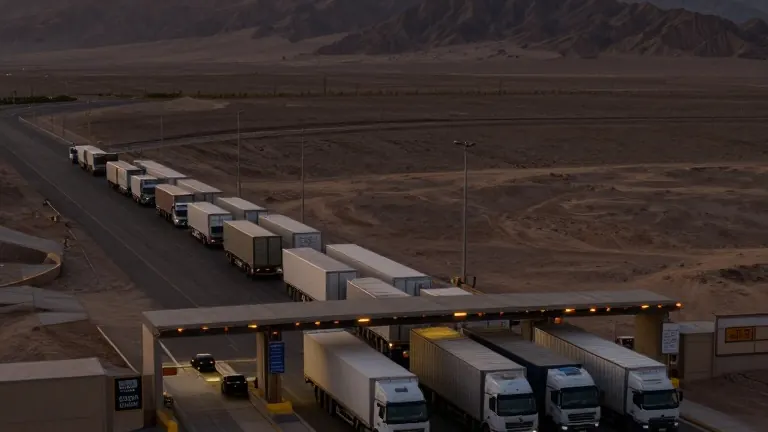
The United States has established Task Force Iron Gate to intercept advanced weapons and sanctioned materials moving across Iran's land borders and the Caspian Sea. Central Command (CENTCOM) announced the formation of the new unit on Saturday, marking a shift from maritime restrictions to overland enforcement. The task force will operate from Tampa, Florida, with an internal staff of approximately 20 civilian and military personnel.
Admiral Brad Cooper, the CENTCOM Commander, stated that the new team will coordinate with other US government agencies. The goal is to stop the movement of weapons systems, dual-use technologies, and illegal revenue streams. Cooper said the initiative reinforces the existing naval blockade, which has already prevented Iran from exporting over $25 billion in crude oil in recent months. He added that the collaboration aims to constrain Iran's ability to finance terrorism and rebuild its weapons factories.
Iran shares land borders with seven countries, totaling a perimeter that presents a logistical challenge for US monitors. The longest border is with Iraq, stretching 1,599 kilometers. Turkmenistan follows with a 1,148 kilometer border, and Afghanistan with 921 kilometers. The border with Pakistan measures approximately 900 kilometers. Shorter borders include Azerbaijan at 611 kilometers, Turkey at 534 kilometers, and Armenia at 44 kilometers.
The timing of the announcement follows the US midterm elections, a period when critics of the Iran war have gained power in Congress. This political shift may limit the time available for the US to execute new operations. The previous naval blockade lasted eight months before the current phase began. CENTCOM noted that strict enforcement continues against ships entering or departing Iranian ports.
Analysts point to the complex web of regional alliances as a factor in the operation's difficulty. Pakistan has complex ties with Iran and maintains good relations with China, which may use Islamabad as a supply conduit. However, Pakistan also has warm relations with the current US administration and is part of the new Mecca Defense Alliance pact alongside Saudi Arabia and Turkey. The United States has already pressured Iraq to cut off Iranian air routes, but numerous Iranian-backed militias operate within Iraqi territory.
It remains unclear exactly what supplies Iran is importing from Pakistan, Afghanistan, and Central Asia. The regime continues to build missiles and drones using materials from Russia and China. Unlike a naval blockade that focuses on specific shipping lanes and ports, monitoring land borders requires tracking a complex network of roads, commercial transport companies, and border crossings. The US Rewards for Justice program is currently offering millions of dollars for information on Iran's nuclear program, running parallel to these new enforcement measures.