Chile's Atacama Desert blooms after historic El Niño rains
Record precipitation has triggered the region's largest floral display in three decades, drawing crowds and prompting a push for UNESCO World Heritage status.
By Lorenzo Evans ·
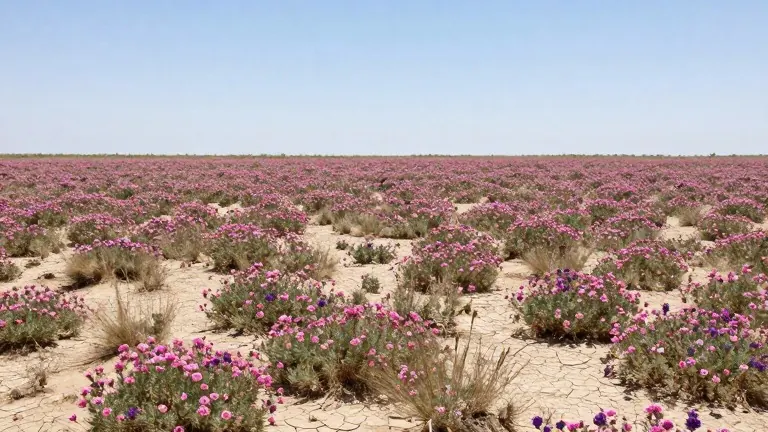
Chile's Atacama Desert is currently covered in a dense carpet of pink, yellow, lilac, and purple flowers following the heaviest rainfall recorded in the region since the 1950s. The bloom, triggered by El Niño weather patterns, represents the largest and most colorful display in the arid zone in thirty years.
Heavy rains in July and August caused flash floods that damaged or destroyed dozens of homes and forced hundreds of residents to evacuate. The water penetrated deep into the soil, activating millions of dormant seeds, bulbs, and tubers. More than 200 species are now in flower, with many plants emerging from crevices where they had remained underground for decades.
Moisés Grimberg, administrator of Llanos de Challe National Park, describes the event as a natural seed bank coming to life. The park, which spans 113,000 acres along the coast, typically welcomes about 10,000 visitors annually. However, 15,000 tourists visited in just the last few weeks. Chile's national tourism board projects approximately 300,000 overnight trips during the two-month flowering season.
Among the most visible species is the garra de león, a crimson flower with flame-like green leaves that grows only on this specific stretch of coastline. The bloom creates a temporary ecosystem supporting insects, lizards, bats, and guanacos. Biologists from INIA, Chile's national seed bank, are collecting specimens to analyze genetic material and study plant adaptations to the arid environment.
Ana Sandoval, a biologist with INIA, noted that the desert appears empty until the right conditions trigger its awakening. She is collecting seeds to preserve the genetic diversity of species that have evolved to harvest water through specialized leaves and waxy cuticles. The current flowering season is expected to conclude by mid-November 2026.
Miguel Vargas, the governor of the Atacama region, has initiated the process to seek UNESCO World Heritage recognition for the phenomenon. He stated that the designation would strengthen special interest tourism and diversify an economy currently dependent on mining. Vargas aims to make the Atacama region Chile's eighth World Heritage site within the next couple of years.
Scientists remain uncertain if this specific bloom is the largest on record. As the flowers fade, researchers will examine the collected specimens to determine if any previously unknown species exist within the millions of plants that emerged.