US Launches Task Force Iron Gate to Disrupt Iran's Supply Lines
A new US military unit aims to block advanced weapons from entering Iran via land and sea, but experts question its effectiveness without regional cooperation.
By Khalid Khalil ·
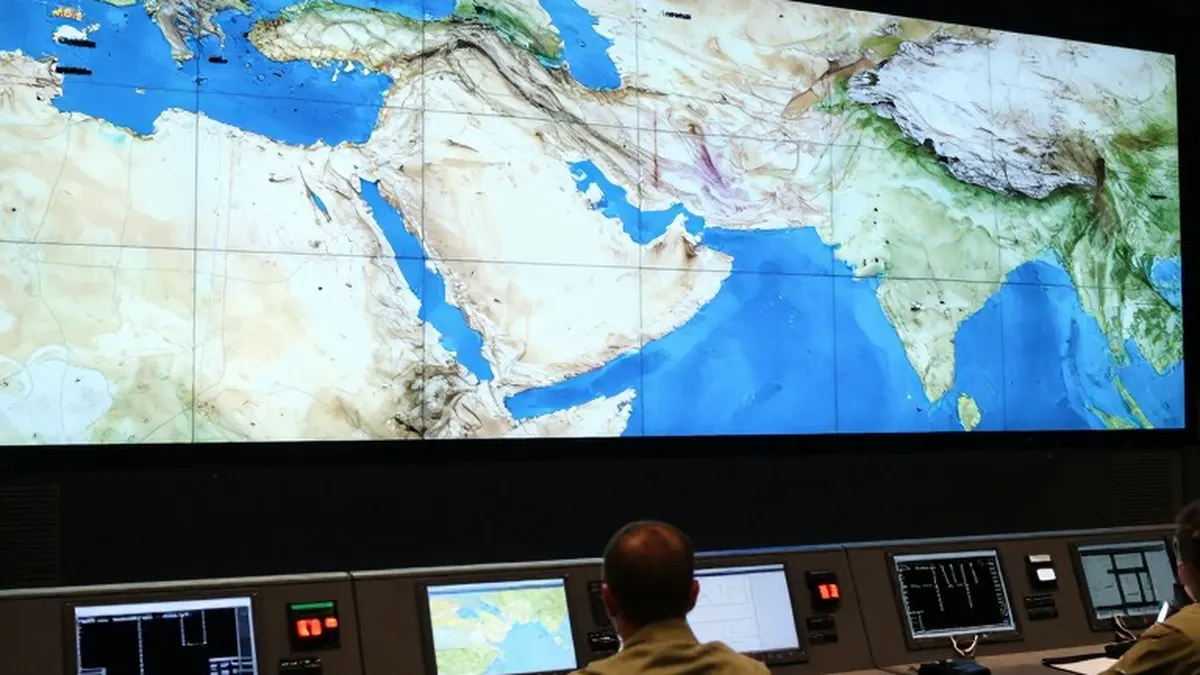
The United States has introduced a new military initiative designed to restrict the flow of goods into and out of Iran. President Donald Trump posted on Truth Social on Sunday, claiming that very little now enters or exits the country. This statement came one day after the US Central Command announced the formation of Task Force Iron Gate, a unit focused on targeting land routes and the Caspian Sea.
According to CENTCOM, the task force is based in Tampa, Florida. It will coordinate with other government agencies to prevent the movement of advanced weapons, dual-use technologies, and sanctioned materials across Iran's borders. The unit is described as an intelligence fusion cell that will use satellite imagery, drones, and intercepted communications to monitor supply networks.
Trump asserted that the task force is already in full force and effect. He suggested that, combined with the existing US naval blockade of the Strait of Hormuz, these measures have virtually cut off Iran from the global trade network. However, military analysts caution that a small intelligence-focused unit cannot fully seal the country's extensive borders without the support of neighboring states.
Andreas Krieg, an associate professor of defence studies at King’s College London, characterized the move as a desperate attempt to extend the naval blockade into Iran's continental supply networks. He noted that while the unit aims to make procurement slower and riskier for Tehran, it is not designed to stop every shipment. Krieg emphasized that the operation relies heavily on intelligence sharing and financial pressure rather than a large troop presence.
The task force may also target connections between Iran and Russia. US media reports indicate that Russia has sent drone components and explosives to Iran via the Caspian Sea. There are also claims that Russian technology is assisting Iran in developing supersonic cruise missiles. While CENTCOM did not explicitly name Russia in its announcement, analysts believe the unit is intended to disrupt these specific supply chains.
Political obstacles remain a significant hurdle. Krieg argued that Iran's neighbors are largely unwilling to cooperate fully. Iraq has some leverage for Washington, but Iranian-aligned networks are deeply embedded there. Azerbaijan might cooperate discreetly, while Turkmenistan is reluctant to jeopardize its neutrality. Pakistan, which is currently mediating between Washington and Tehran, is unlikely to participate openly, and Turkiye has little interest in another border confrontation.
Rami Khouri, a public policy fellow at the American University of Beirut, described the mission as near impossible given Iran's long history as a trading nation. He pointed out that Iran has an enormous web of contacts with traders and partners across the region, particularly in Asia. These deep ties make it difficult for the US to seal off every single point of entry.
Concerns have also been raised about the potential for mission creep. Krieg warned that intelligence gathering could lead to pressure for seizures or military strikes on logistical infrastructure in neighboring sovereign territories. This could extend the economic war into new arenas and prompt asymmetric responses from Iran, such as increased maritime coercion in the Strait of Hormuz.
Joe Kent, a former US counterterrorism official, argued that the task force is an attempt to subvert ongoing diplomatic efforts. He stated that the military is finding ways to ensure the war escalates while the White House attempts to negotiate. The Wall Street Journal reported that CENTCOM chief Brad Cooper and Defense Secretary Pete Hegseth are pressing Trump to renew attacks on Iran.
Mahjoob Zweiri, a professor at Qatar University, suggested the initiative may be largely symbolic. He noted that the US lacks direct access to the Caspian Sea and would need cooperation from countries like Azerbaijan or Armenia to be effective. Since these nations are hesitant to upset Russia, Zweiri believes that without troops on the ground, the task force will have limited practical impact.