Pyongyang begins mass drone output with Russian technical aid
Moscow is exchanging military technology for North Korean troops, workers, and weapons as Pyongyang expands its unmanned systems and missile capabilities.
By Khalid Khalil ·
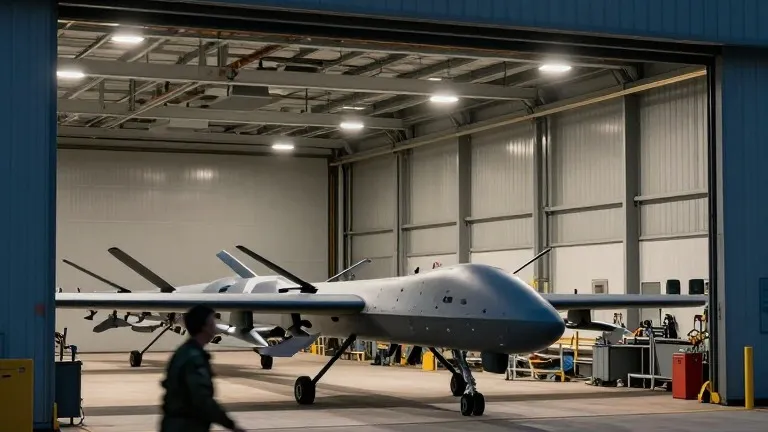
North Korea has commenced the mass production of attack drones and continues to upgrade its ballistic missiles, a process heavily supported by Russian technical assistance. The New York Times reported that this expansion is part of a growing military exchange between Moscow and Pyongyang.
Moscow is transferring its own military developments to North Korea. In return, Pyongyang is supplying Russia with soldiers, industrial workers, and weaponry. This partnership intensified after Russia launched its full-scale invasion of Ukraine, prompting North Korea to modernize its armed forces using Russian resources.
Pyongyang recently demonstrated its improved missile capabilities. In early October, the country tested a tactical ballistic missile that it claims can carry a nuclear payload. South Korean and Japanese officials estimated the missile traveled approximately 700 kilometers, while North Korea asserted a range of 1,000 kilometers. Analyst Anton Ponomarenko stated that access to Russian deployment data and feedback has helped North Korea improve the accuracy and maneuverability of these weapons, making the threat to South Korea more substantial.
South Korea responded to the October test with its own first test-fire of a hypersonic ballistic missile. President Lee Jae Myung observed the launch, which took place five days after the North Korean test. The New York Times noted that Seoul typically issues short statements describing such North Korean launches as provocative, but this direct military response signals increasing unease over Pyongyang's rapid technological progress.
Russia has also guided North Korea in building and producing unmanned systems in large numbers. The New York Times observed that Pyongyang has studied how inexpensive drones can overwhelm costly air defense systems in Ukraine and the Middle East. During a drill last month, a North Korean drone swarm attacked a target island simultaneously with cruise and ballistic missiles launched from different directions. The newspaper argued that these tactics will force South Korea and its allies to redesign their air defenses at a high cost.
This development follows earlier reports on the bilateral military cooperation. Bloomberg reported in September that Russia employs up to 25,000 North Korean citizens to produce military drones, particularly at facilities in Alabuga, Tatarstan. A North Korean missile forces unit, potentially equipped with 120 ballistic missiles and six launchers for strikes against Ukraine, has also begun deploying in western Russia. In June 2026, North Korea announced tests of a modernized 240mm multiple-launch rocket system, a tactical ballistic missile, and a 155mm long-range artillery shell.
The exchange of resources continues to shape the military balance in the region. Russia requested KN-30 ballistic missiles from North Korea in August. The ongoing transfer of technology and personnel indicates a deepening integration of the two military forces.
Source: Ukrainska Pravda