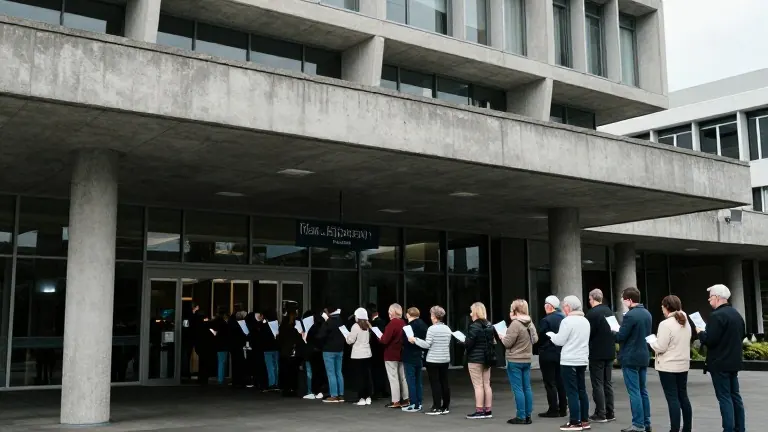
New Zealand election too close to call as Luxon claims mandate
New Zealand faces weeks of political uncertainty after a knife-edge election that produced no outright winner and saw record gains for minor parties.
By Lorenzo Evans ·
New Zealand was bracing on Sunday for weeks of coalition negotiations after a tightly fought parliamentary election failed to deliver a clear winner, with both major blocs claiming paths to power.
Preliminary results gave Prime Minister Christopher Luxon's National Party the largest share of seats, with 42 in the projected tally, ahead of the opposition Labour Party on 36, according to the electoral commission. Combined with coalition partners NZ First and ACT, the right-wing bloc would hold a slim majority of just two seats.
Luxon declared that his coalition had a mandate to govern while acknowledging the result remained too close to call with certainty. "New Zealanders have given us the biggest seats in parliament, 42 seats as it stands today, and a pathway to form a government," he told journalists. "There's no doubt about it. We've got a mandate."
He argued his party had performed well despite the economic fallout from the war in the Middle East and the global fuel shock that followed, factors widely blamed for New Zealand's economic troubles. "What we achieved, I think, was pretty good," he said.
Labour leader Chris Hipkins, whose left-wing alliance includes the Green Party and Te Pati Maori, faces a far narrower route to power. He joked that while voters had spoken, "it may take us a little bit longer to figure out exactly what it is that you've said".
Luxon will lead a caretaker government until the final results are declared on November 27. That count will include nearly 400,000 special votes, among them around 100,000 cast overseas or by people voting outside their home electorates. Special votes have historically leaned left, which could add one or two seats for Labour or the Greens at the expense of the right bloc.
The election also brought record gains for minor parties, with particular attention on the centrist Opportunity Party, which is projected to win seven seats and could play a kingmaker role. Under New Zealand's mixed-member proportional system, voters cast two ballots, one for a party list and one for a local electorate representative. The Greens placed third with 16 seats, followed by ACT on 13, NZ First on 12 and Te Pati Maori on five.
Luxon said it was unlikely he would need Opportunity to form a government but signalled openness to working with its leader, Qiulae Wong, on shared priorities. "We can work with our current coalition partners to form the government," he said, while adding that there was a need for deeper cross-party collaboration going forward. He also suggested the country wanted a pause from politics. "I think everyone's over politics, so let's all just have a bit of a break for the next three weeks."
Cost of living pressures dominated the campaign, with prices for basic goods still elevated and unemployment at its highest level in more than a decade. On the streets of Wellington, voters told AFP the issue had shaped their choices. Rahul Jain, a 33-year-old support worker, said he hoped the next government could "bring the cost of living down", adding: "Everything has gone up, so that's the biggest issue right now."
Mary Scott, a lending operations representative, said she wanted leaders to keep ordinary New Zealanders in mind. "I know we're always going to be impacted by overseas events, but what's happening here?" she said. "They can actually do a lot with the money they have in the bank, and they can make fair policies for everyone. They can make the wealthy pay a bit more."