Hera spacecraft arrives to analyze asteroid impact site
The ESA mission has reached the Didymos system to study the aftermath of the 2022 Dart collision and assess planetary defense capabilities.
By Khalid Khalil ·
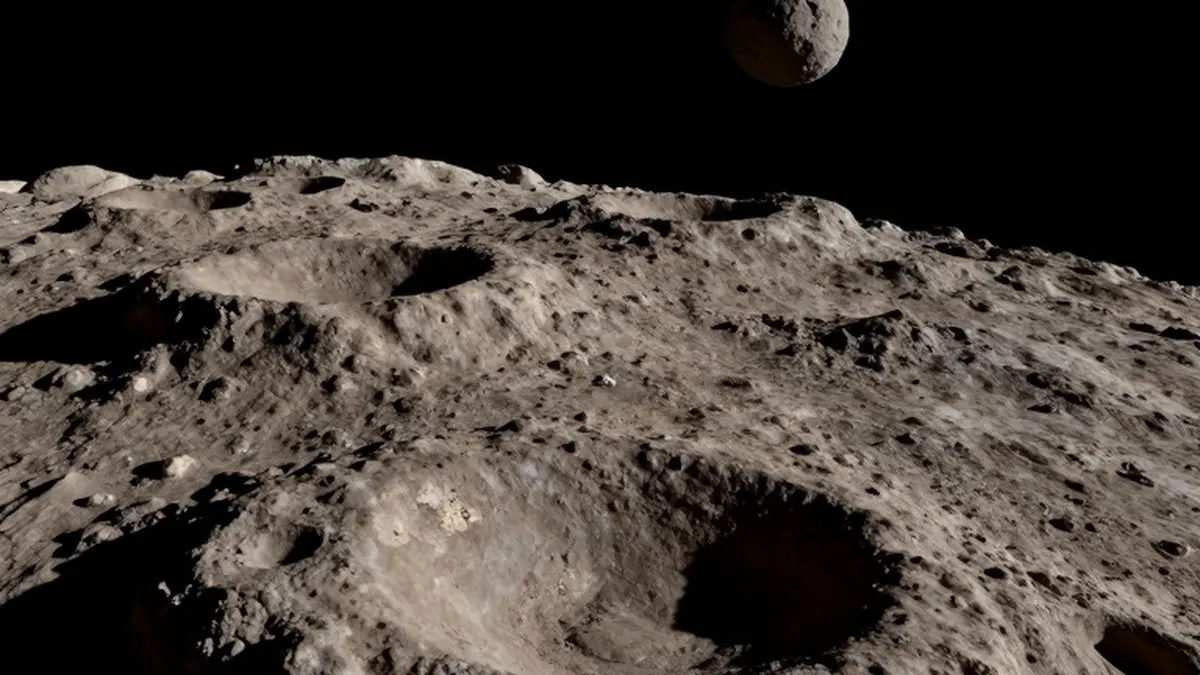
A European Space Agency spacecraft has arrived at a binary asteroid system to investigate the lasting effects of a deliberate collision. The Hera mission is currently assessing the damage left behind by Nasa's Double Asteroid Redirection Test (Dart) spacecraft, which impacted the smaller body in 2022. The first visual data from this investigation is scheduled for release on Wednesday.
The 2022 event marked the first real-world test of planetary defense strategies. While the target asteroid poses no immediate threat to Earth, the exercise was designed to determine how effectively humanity could deflect a space rock if one were on a collision course. Patrick Michel, the principal investigator for Hera, described the mission as an investigative return to the scene, comparing the spacecraft to a detective examining the outcome of the impact.
The Dart probe targeted Dimorphos, a small moon orbiting the larger asteroid Didymos. Didymos measures approximately 730 meters in diameter, while Dimorphos is about 150 meters wide. The Dart spacecraft struck its target at a speed of 22,000 kilometers per hour. Telescopes on Earth and in orbit detected a debris trail extending roughly 10,000 kilometers from the impact site.
The collision successfully altered the orbital period of Dimorphos. Prior to the impact, the smaller asteroid took 11 hours and 55 minutes to complete an orbit around Didymos. Following the Dart strike, this duration decreased by approximately 33 minutes. However, because the Dart spacecraft was destroyed upon impact, scientists lack detailed information about the final physical state of the asteroid.
Hera will spend the coming year conducting a detailed study of both asteroids. Its primary objectives include determining whether the impact created a crater and, if so, measuring its size and depth. The mission also aims to ascertain if the collision fundamentally reshaped the surface of Dimorphos. The spacecraft is equipped with various instruments and carries two small cube satellites that can fly close to the impact site and eventually land on the surface.
A critical goal of the mission is to measure the mass of Dimorphos. This data will help researchers understand the efficiency of the kinetic impactor method. Prof Simon Green, a planetary scientist on the Hera science team, noted that such information is vital for future scenarios. It would allow scientists to calculate the mass and velocity required to deflect an asteroid far enough to miss Earth.
Asteroids of different sizes present varying levels of risk to our planet. Objects larger than one kilometer could cause global devastation, while medium-sized rocks similar to Dimorphos could destroy a city. Carolyn Ernst from the Johns Hopkins Applied Physics Laboratory emphasized that while the largest threats have been identified and none are currently heading for Earth, the middle-size range remains a concern.
The atmosphere protects Earth from smaller fragments, but the medium-sized range presents a challenge because not all objects in this category have been fully cataloged. Understanding these risks is essential for preparedness. To aid in this effort, a new space telescope called the Near-Earth Object Surveyor is scheduled to launch in 2027 to track potentially hazardous asteroids.
Future missions will also focus on the asteroid Apophis, which is approximately 450 meters long. Discovered in 2004, Apophis was initially thought to pose a significant impact risk in 2029. Current orbital data indicates it will pass within 32,000 kilometers of Earth's surface, a distance that allows for close observation without collision risk for at least the next century.
Two spacecraft are planned to visit Apophis to gather further data. These include Nasa's Osiris-Apex, which previously collected samples from the asteroid Bennu, and Ramses, a joint mission between the European Space Agency and the Japanese Space Agency. These efforts collectively aim to enhance humanity's ability to monitor and respond to threats from space.