ESA releases detailed images of asteroid after DART impact
New data from the Hera mission reveals a massive crater on Dimorphos and hundreds of moving boulders, confirming the success of the first planetary defense test.
By Lorenzo Evans ·
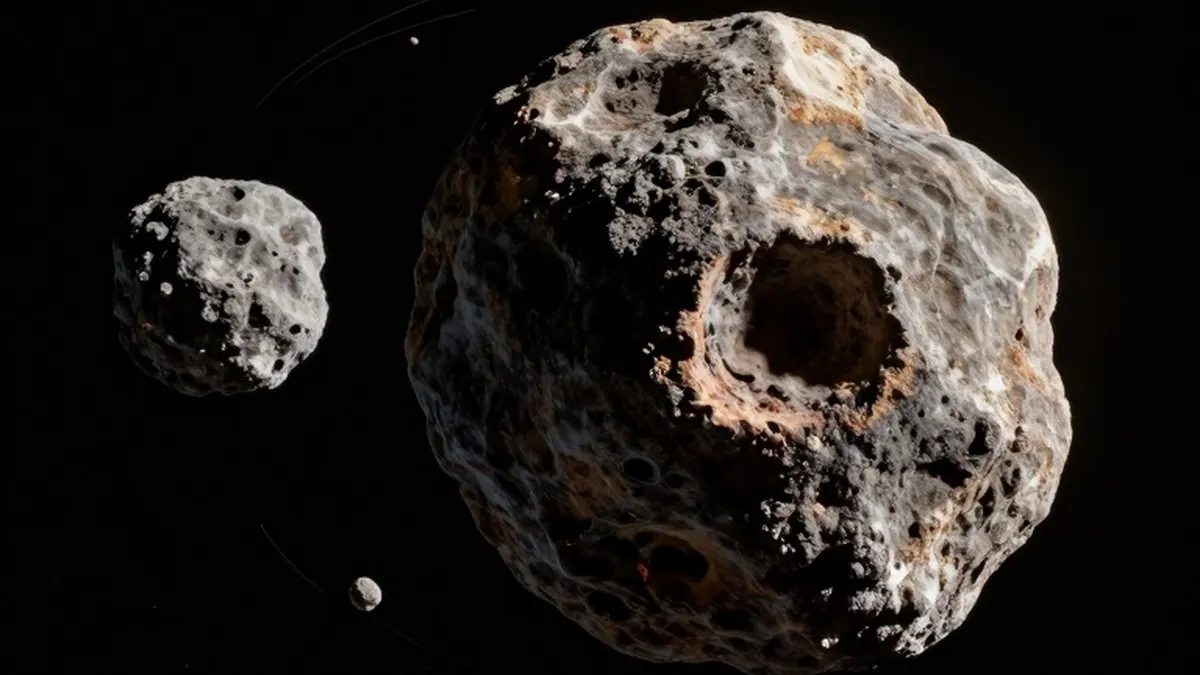
The European Space Agency has released close-up images and videos of the Didymos and Dimorphos binary asteroid system, providing the first detailed look at the aftermath of NASA’s Double Asteroid Redirection Test. This mission, known as Hera, aims to assess the long-term effects of the 2022 impact that was designed to alter the orbit of the smaller moonlet, Dimorphos.
In 2021, NASA launched the DART spacecraft with the goal of testing whether a kinetic impact could change the trajectory of a potentially hazardous asteroid. The target was Dimorphos, which orbits the larger asteroid Didymos. When DART struck Dimorphos in September 2022, it successfully shortened the moonlet's orbit around its parent body by approximately 33 minutes. This result exceeded NASA's initial prediction of a ten-minute change.
Planetary scientist Sabina Raducan, who is part of the Hera mission team, described the visual changes as spectacular. She noted that the previously rounded face of Dimorphos has been transformed into a large crater that is nearly as big as the asteroid itself. The images show a flattening of the surface and strange internal structures, including an apparent cigar-shaped formation at the center of the impact site.
Beyond the crater, the Hera team discovered an unexpected phenomenon: hundreds of boulders moving around the two asteroids. Naomi Murdoch, another planetary scientist on the team, explained that these objects range in size from tens of centimeters to several meters. The motion of these boulders is visible in composite images created from long-exposure photographs, appearing like swarming fireflies. It remains unclear whether these rocks were displaced by the 2022 impact or were part of the system prior to the collision.
The impact also altered the rotational behavior of Dimorphos. Before the collision, the moonlet was tidally locked, meaning it always presented the same face to Didymos, similar to how Earth's moon behaves. Now, Dimorphos tumbles chaotically as it orbits. This change in dynamics is a significant finding for planetary defense models.
Further analysis has revealed that the DART impact had a broader effect than initially measured. A study published in Science Advances in March reported that the collision changed the pair's 770-day orbital period around the sun by a fraction of a second. While the time difference is minute, it marks the first time a human-made object has altered the orbit of a body around the sun.
Hera has been orbiting the system for the past three weeks and has approximately six months remaining in its primary mission. During this period, the spacecraft will deploy two CubeSats to study the mineral composition of Dimorphos and perform the first radar sounding within an asteroid. The main spacecraft and its probes will eventually descend to the surface to gather more data.
Scientists are eager to determine how efficient the deflection was, as this information is critical for future planetary defense strategies. Raducan emphasized that while the tests confirm that deflection is possible, understanding the precise mechanics will require further analysis of the data collected by Hera. The mission represents a crucial step in humanity's ability to protect Earth from potential asteroid threats.
The Didymos system itself presents interesting geological features. Didymos, which is 700 meters wide, resembles a giant walnut with a pronounced ridge across its surface. Murdoch explained that the asteroid rotates very fast, causing surface material to flow from higher latitudes toward the equatorial region, which likely formed the ridge. These observations provide valuable insights into the behavior of fast-rotating bodies in the solar system.