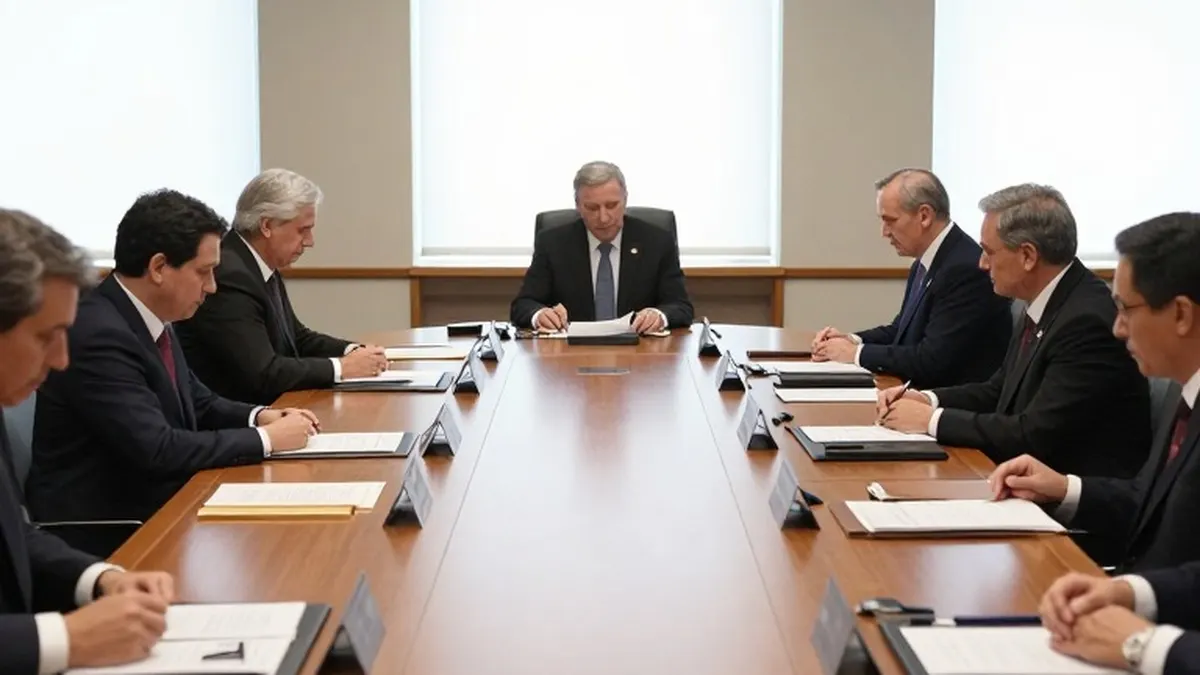
Japan and China Face Diplomatic Stalemate After Friction at APEC Summit
Friction at the APEC summit in Shenzhen underscores the deepening diplomatic rift between Japan and China, driven by security concerns and economic leverage.
By Evelyn Adeyemi ·

The recently concluded Asia-Pacific Economic Cooperation summit in Shenzhen, China, highlighted the growing tension between Beijing and Tokyo. Japanese Prime Minister Sanae Takaichi arrived on November 18 for the two-day event, but her reception was notably subdued compared to that of other regional leaders. A minor logistical error occurred when the mobile stairs for her aircraft stopped short of the plane's threshold, forcing the Prime Minister to descend a significant distance to reach the tarmac.
Observers suggest this incident may have been more than a simple oversight. William Yang, a Taiwan-based analyst for the International Crisis Group, described the moment as a clear display of frostiness. He noted the stark contrast between Takaichi's low-key arrival, which lacked musical performances or traditional dances, and the more elaborate welcomes extended to other APEC leaders. The tension persisted when Takaichi met Chinese leader Xi Jinping at a dinner reception, where her attempt to engage him in conversation was met with a cold reaction.
The Japanese delegation was also denied a brief one-on-one meeting with Xi Jinping, a courtesy granted to many other participants. The Yomiuri newspaper reported that the atmosphere during the dinner was chilly, reflecting the current state of bilateral relations. This diplomatic chill is rooted in a complex history that includes the Japanese invasion of China in the 1930s and the subsequent occupation of captured cities.
While diplomatic relations were normalized in 1972, Japan's policy of engagement began to shift in the mid-2000s. David Adebahr, a professor at Kobe University, points to factors such as China's rising military spending and the breakdown of talks over the East China Sea in 2006. These issues, combined with a resurgence of nationalism, led to increased concerns among Japanese diplomats about Chinese submarine activity near their waters.
The relationship took a sharp turn in November 2025 when Prime Minister Takaichi stated in the Diet that any contingency involving Taiwan would inevitably threaten Japan's national security. Although Adebahr argues she was merely articulating existing internal security logic, Beijing reacted with fury. China has since demanded that Takaichi retract the statement and has applied pressure by restricting exports of rare earth minerals, banning Japanese seafood imports, and advising tourists to reconsider visiting Japan.
Beijing appears to hold significant leverage in the current standoff. Adebahr notes that Japan's dependence on Chinese rare earths, along with a more visible Chinese military presence, gives China considerable bargaining power. The current US administration has also urged Tokyo to de-escalate tensions rather than offering firm backing, which reduces China's incentive to offer a face-saving compromise.
Takaichi faces a difficult balancing act as a conservative leader who has spoken tough on Beijing's military buildup. Yang describes her position as a political tightrope, where she must manage tensions with China while preparing for potential contingencies over Taiwan. He predicts that China will continue to step up pressure by limiting targeted exports and aligning its assertions with Russia and North Korea regarding Japan's remilitarization.
Despite the current friction, a full decoupling of the two economies remains unlikely. Adebahr emphasizes that trade, technology, and critical minerals are now viewed as security issues, creating a complex interdependence. While economic ties alone may not stabilize the relationship, the high transaction costs of separating completely suggest that both nations will continue to navigate a path of cautious engagement.