Army declares Iowa lead azide detonation a success despite local criticism
US Army officials report the controlled destruction of 68 drums of volatile lead azide in Iowa was a success, although local representatives criticize the timing and communication surrounding the operation.
By Khalid Khalil ·
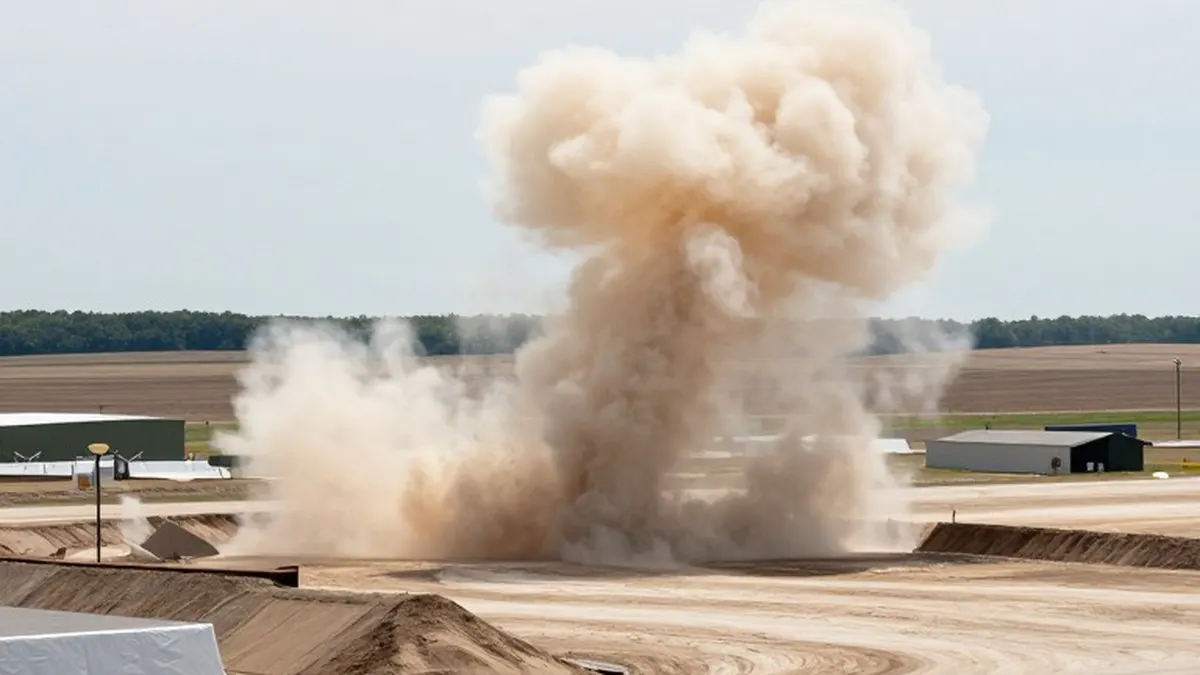
US Army officials have described the recent mission to destroy 68 drums of volatile lead azide at a military base in Iowa as a major success. The controlled detonation, which took place on Wednesday, was designed to eliminate a sensitive munitions explosive that had been deteriorating at the facility.
Major General Eric Shirley, the Army official leading the disposal effort, addressed a news conference in Middletown. This rural city in southeastern Iowa is adjacent to the ammunition plant where the operation occurred. Shirley stated that overhead footage confirmed that all lead azide barrels were definitively removed. He characterized the operation as tremendously successful, noting that the results wildly exceeded expectations.
The explosion at 10:15 am local time destroyed approximately 4,500 kilograms, or 10,000 pounds, of the unstable material. Lead azide has been used in military munitions since World War I. Shirley reported that there were no secondary explosions, no kick-out effects, and no damage to the infrastructure within or around the installation.
To manage the impact of the blast, officials implemented extensive mitigation measures. These included earthworks, foam barriers, and gel blocks designed to absorb shockwaves and toxic fallout. Despite these precautions, the timing of the event drew criticism from local political figures.
Democratic Illinois House Representative Mike Quigley expressed dissatisfaction with how military leaders handled the operation. In a statement posted on X, Quigley called the scheduling on the eve of the Thanksgiving holiday and the lack of communication unconscionable. He noted the unfairness of releasing 9,500 pounds of unstable lead azide on the people of Iowa just before the major holiday.
Following days of heightened alarm regarding lead dust contamination and environmental repercussions, federal officials provided updates on air quality. Preliminary data from Environmental Protection Agency sensors indicated that no airborne lead particles were detected. The EPA stated that all real-time air monitors in the region were reporting zero detection of airborne lead.
Ongoing monitoring efforts continue in the blast zone. Chemists have noted that lead is a nonbiodegradable element that cannot be chemically destroyed. It persists in the environment, and airborne particles can travel considerable distances before settling on soil or leaching into groundwater. The detonation decomposed the compound into nitrogen gas and metallic lead.
Lead is a potent neurotoxin that poses significant threats to children and pregnant women. It is linked to learning disabilities, impaired neurological function, and other health issues. Scott Smith, an independent environmental testing expert, emphasized the need to test for breakdown products and stabilizers. He noted that some of these chemical components are endocrine disruptors and potential cancer-causing agents.
The Army Sustainment Command announced it would release a final breakdown of the affected area after the operation. This report will include maps of lead-dust dispersion and surface deposition. Shirley expressed strong confidence in the safety of the surrounding communities, stating that the risk to health and safety in Middletown and the extended Iowa communities had been reduced as close to zero as possible.