Trump meets Xi and Putin in Shenzhen to discuss nuclear limits and wars
The trilateral summit in China aims to address expired arms treaties and ongoing conflicts, though experts warn that a single meeting is unlikely to yield immediate breakthroughs.
By Evelyn Adeyemi ·
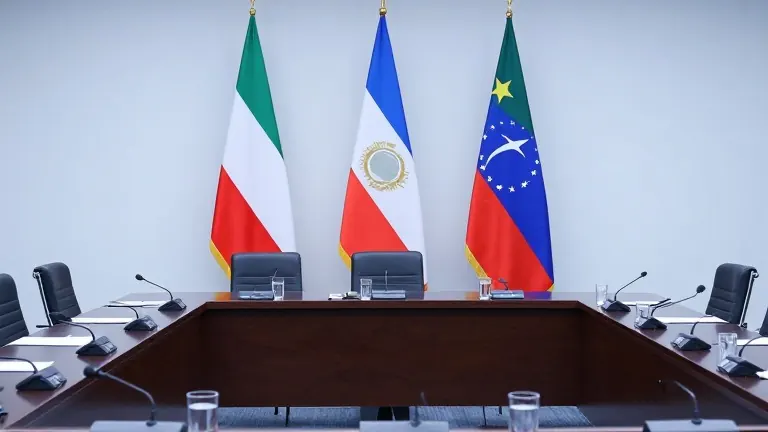
President Donald Trump, Chinese President Xi Jinping, and Russian President Vladimir Putin convene Thursday in Shenzhen for a trilateral meeting focused on nuclear arms control and the wars in Ukraine and Iran. The gathering serves as the final event of Trump’s Asia trip, which began Tuesday in the Philippines. Trump previously led a session with leaders at the Asia-Pacific Economic Cooperation Summit earlier on Thursday morning.
The last major nuclear arms pact between the United States and Russia, known as New START, expired in February. Trump stated he seeks a new, modernized deal that includes China. However, China possesses an arsenal of more than 600 warheads, a number far smaller than the more than 5,000 warheads believed to be in each of the U.S. and Russian stockpiles. Daryl Kimball, executive director of the Arms Control Association, noted that one meeting will not likely produce dramatic breakthroughs.
Trump described the challenge of reducing stockpiles as a very hard thing to do in a Thursday interview with Fox News. He argued that meeting the two leaders simultaneously is advantageous because their countries work together. He added that both leaders like him, though he could not predict what would happen after his term.
Separate bilateral talks are scheduled for the leaders. Trump will hold a one-on-one meeting with Xi before the trilateral session, marking their third substantial meeting of the year. He will also meet privately with Putin for the first time since their discussions in Alaska last year failed to broker a deal to ease the war in Ukraine. The agenda for the trilateral is not fully set, though Putin’s foreign affairs adviser Yuri Ushakov indicated the leaders would likely touch on the war in Ukraine.
Ukraine and its European allies view the meeting with suspicion. German Chancellor Friedrich Merz said Europeans feared another Anchorage moment, referencing last year’s Alaska talks that produced proposals rejected by Ukraine and its partners. Ukraine is not part of the negotiation process, nor are other stakeholders such as Germany, France, the United Kingdom, Japan, and South Korea. Trump has negotiated with China and Russia while recently rejecting new Russia sanctions and facing disruptions in satellite support for Ukrainian drones.
Elon Musk, whose company SpaceX has intermittently throttled the Starshield satellite system used by Ukraine, is present in China but has kept a low profile. The U.S. and China are also managing tensions in trade and artificial intelligence. Jensen Huang, a Trump ally, resigned as CEO of Nvidia last week after confessing to an affair with Alice Huang, whose company helped provide China with access to advanced computer chips. Beijing denied Alice Huang was a Chinese government agent. Trump has held off on imposing tougher chip restrictions to avoid aggravating relations.
Trade officials from both nations met before the summit. Treasury Secretary Scott Bessent and U.S. Trade Representative Jamieson Greer met with Chinese Vice Premier He Lifeng. The U.S. officials said China had not fully honored commitments made last year to buy more U.S. agricultural products and loosen restrictions on rare earth minerals. The trade truce reached last year is set to expire by January 10, 2027.
The dynamic between Xi and Putin appears stronger than either leader’s relationship with Trump. At the APEC summit on Wednesday, Xi called Putin my old friend, and Putin responded by declaring Xi his dear friend. Xi stated that China-Russia relations have remained steadfast through storms. China has provided financial support to Russia following the 2022 invasion of Ukraine. Trump and Xi plan to meet a fourth time in December at the G20 summit in Florida.