Satellite data reveals massive oil pollution in Gulf waters following naval conflict
Satellite imagery reveals that over 500 oil spills in the Gulf since the start of the war have created a pollution area the size of Wales, threatening fragile marine ecosystems.
By Lorenzo Evans ·
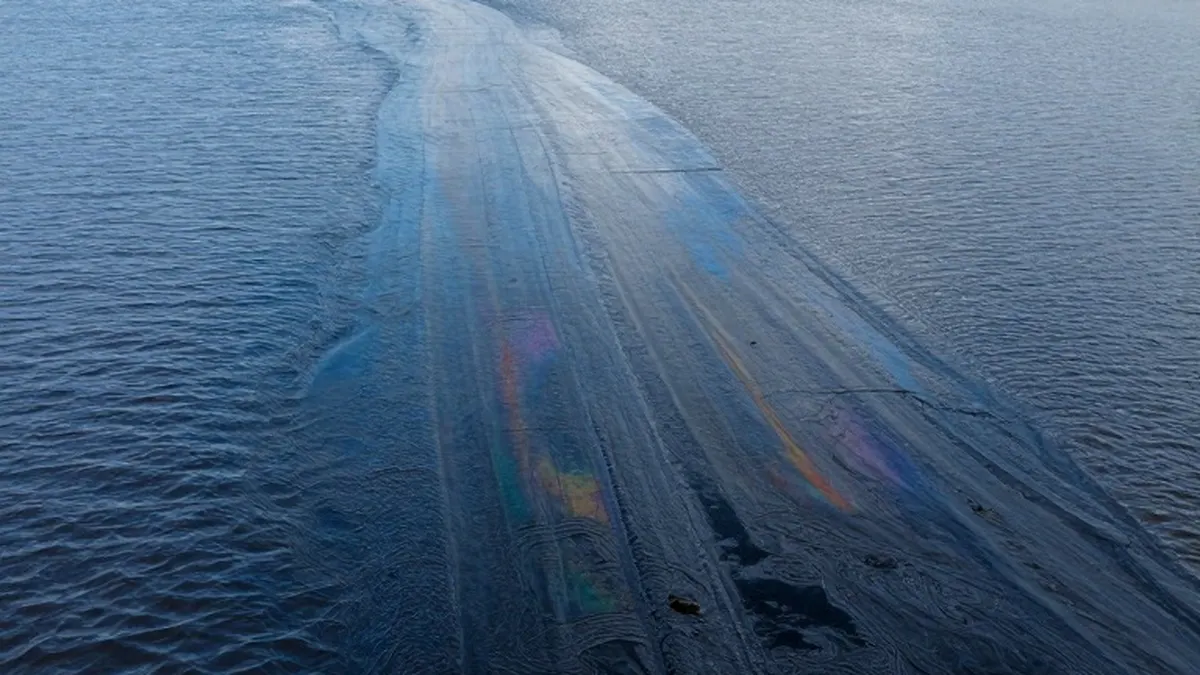
Large, dark oil slicks are now visible from orbit in the strait of Hormuz, marking a significant environmental crisis. Throughout October, crude oil tankers were hit by missiles or sea mines, releasing large volumes of oil into the waterway. This pollution has spread across the Gulf, contaminating coastlines and threatening the long-term health of marine ecosystems that support dolphins, sea turtles, and diverse fish populations.
Eight months after the war began between the United States and Iran, one of the world's busiest shipping lanes has become a focal point for both military action and environmental damage. A naval blockade has made it difficult to document the pollution from the ground. However, satellite image analysis combined with expert testimony is helping to clarify the scale of the disaster.
The strait of Hormuz is the sole maritime link between the Gulf and the Arabian Sea. It contains a rich but delicate marine environment, including coral reefs, mangrove forests, and seagrass meadows. These habitats play a crucial role in water circulation and serve as migration routes for marine mammals. Even before the conflict, these ecosystems faced pressure from shipping, oil extraction, and coastal development.
Oil pollution poses specific threats to marine life. It can coat the feathers of birds, impairing their ability to float and feed. It can also cover mangrove roots, blocking oxygen absorption and potentially killing the trees. Bernhard Riegl, a marine biologist at Nova Southeastern University, warned that the war could cause lasting damage to the confined waters of the Gulf, which are already stressed by the climate crisis. He noted that the shallow nature of the Gulf and summer heat make the waters particularly vulnerable to thermal stress, with no deep cold water to buffer the heat.
Greenpeace has identified more than 500 instances of oil spills across the Gulf, the strait of Hormuz, and the Arabian Sea since the war started on 28 February. Nina Noelle, a Greenpeace expert, stated that the cumulative footprint of these spills is approximately 20,000 square kilometres, an area nearly the size of Wales. More than 133 attacks on oil tankers have been recorded, with October being the most severe month according to the Washington Institute for Near East Policy.
Among the most significant incidents was a strike on the supertanker Gem No 2 off the coast of the United Arab Emirates, which created a slick stretching over 21 miles. Another major spill occurred in early June off the coast of Oman, covering more than 600 square kilometres at its peak. Two Iranian naval vessels hit in March also continued to leak oil for several months. Pollution has reached several coastlines, including areas near the Hara mangroves, Shidvar Island, and Qeshm Island.
While some coastal authorities have responded to specific spills by closing beaches and launching cleanups, the wider damage may be harder to manage. Oil can remain trapped in sediments and mangrove roots long after surface slicks disappear, affecting the marine food chain. Environmentalists warn that mangroves and coral reefs can take decades to recover, especially when oil persists in the sediment. Repeated spills in the strait risk compounding this damage.
Historical data suggests that the current pollution could have long-term consequences. A 2020 study found widespread tar deposits on Qatari beaches linked to the Gulf war. A 2022 study identified oil from the 1983 and 1985 Nowruz spills in sediments on Saudi Arabia's Abu Ali Island. Riegl noted that organisms that dig in beaches, such as sea turtles laying eggs or ghost crabs, continue to encounter contaminated material. He described the situation as a generational problem, warning that the region could lose irreplaceable ecological assets.