Israel heads to polls with no clear winner for 120 Knesset seats
Polls indicate a tight race between Prime Minister Benjamin Netanyahu's bloc and his opponents, setting the stage for potential coalition negotiations or a fourth election in four years.
By Khalid Khalil ·
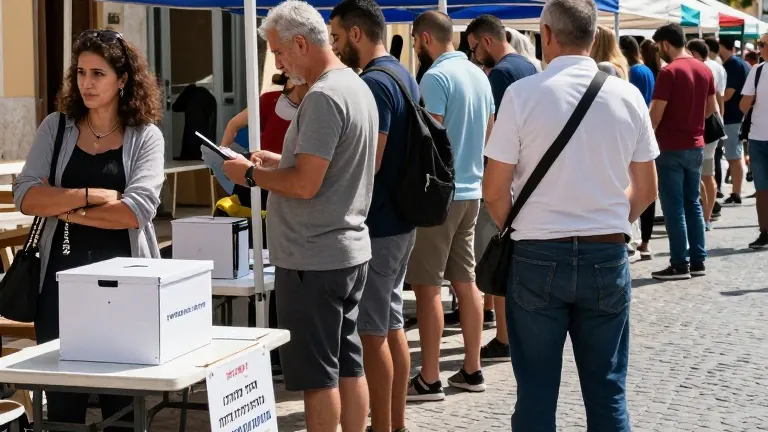
Israelis are voting Tuesday in a parliamentary election that polls predict will produce no decisive winner, leaving the fate of Prime Minister Benjamin Netanyahu's government uncertain. The 120 seats in the Knesset are split between a right-wing and religious bloc led by Netanyahu and a diverse group of opposition parties that want him removed from power. Most recent surveys show neither side will secure the 61 seats required to form a majority government independently.
The vote is the first since the October 7, 2023, Hamas attack, an event authorities have acknowledged as the worst crisis since the state's founding in 1948. The country remains engaged in multi-front conflicts in Gaza, Lebanon, and Syria, with two direct rounds of fighting against Iran already concluded. Netanyahu is advocating for a third confrontation with Iran as a central theme of his campaign.
Netanyahu, the longest-serving prime minister in Israeli history, argues that only he can build a government without relying on Arab parties, which he views as a risk during wartime. He also contends that he needs additional time to complete military objectives in Gaza, Lebanon, and Iran. President Donald Trump recently endorsed Netanyahu, stating that if Israel chooses a different leader, the United States might have to handle the war against Iran alone. Trump said, "If Israel has the wrong Leader, which would be anyone other than Bibi, America will have to do this work ourselves, and I am not inclined to do so."
Netanyahu's campaign slogan in Hebrew translates to "Either right wing or Palestine, either right wing or a nuclear bomb." Over the weekend, he shared an AI-generated image of a nuclear explosion over Tel Aviv on social media to underscore the existential threat he believes Iran poses. Benny Abraham, a restaurant owner and Netanyahu supporter, described the prime minister as a charismatic global figure. "Bibi can handle the whole world," Abraham said. "He's the king of Israel."
The main challenger leading the opposition bloc is Gadi Eisenkot, former military chief and head of the centrist Yashar party. Eisenkot lost his son and two nephews in Gaza and served in the war cabinet alongside Netanyahu for the first year of the conflict. His party has appointed women to about half of its candidate list, a notable contrast to the male-dominated Likud coalition. Eisenkot has criticized Netanyahu for using fear tactics, specifically referencing the nuclear bomb imagery. "This time, it won't work for him," Eisenkot said.
Eisenkot promises to launch a state inquiry into the intelligence and security failures that allowed the October 7 attack, a measure Netanyahu has blocked. Uzi Aharoni, a 73-year-old engineer from Tel Aviv, sees Eisenkot as a neutral and honest alternative. "Eisenkot is not left, he's not right," Aharoni said. "He's the kind of leader who will take care of us, the people of Israel, and not himself or his corrupt family."
Voter turnout among Arab Israelis and Likud supporters could shift the balance of power. Arab citizens make up about 20% of the population. Yohanan Plesner, president of the Israel Democracy Institute, noted that higher Arab turnout reduces the likelihood of Netanyahu forming a coalition with his current far-right allies. Jehad Abomoch, a cafe owner in Baqa al Gharbiya, said many Arab Israelis feel they have "no hope, no future" under the current government. Two new parties are also competing for the Knesset threshold, both demanding that ultra-Orthodox men be subject to mandatory military service.
If neither bloc reaches a majority, the outcome could involve weeks of negotiations, cross-ideological coalitions, or a minority government supported by abstentions. If parties refuse to compromise, Israel may face another election. Between 2019 and 2022, the country held five elections due to similar deadlocks. Plesner said that if politicians stick strictly to their campaign promises and refuse to switch sides, the country will likely return to the polls. "I'm sure that most politicians are not interested in that," he added.
Source: CBS News