Robots block wheelchair access: 45% of students adjust paths at Ohio State
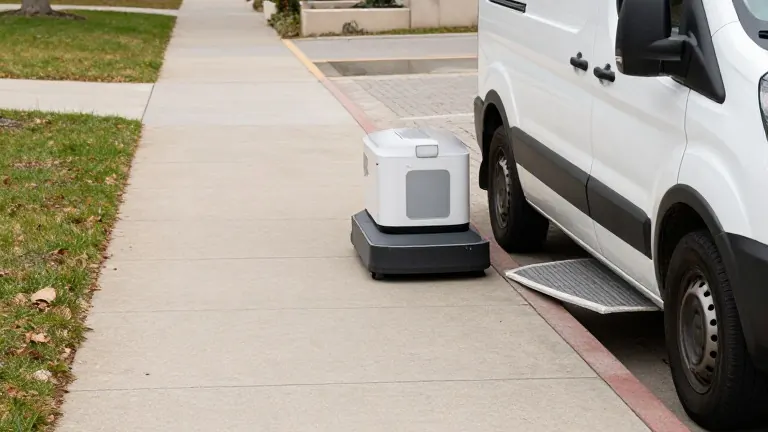
Faculty and students report that Grubhub delivery rovers frequently stop at paratransit ramps, forcing mobility aid users to wait or reroute on narrow sidewalks.
By Khalid Khalil ·
Forty-five percent of 168 surveyed Ohio State University students, faculty, and staff reported making small movement adjustments to accommodate Grubhub delivery rovers, according to unpublished ethnographic research led by anthropology professor Mark Moritz.
The study, conducted in a graduate classroom last spring, found that 36 percent of respondents actively move out of the way or change speed when encountering the robots. Another 4 percent stop walking to let the machines pass, while 14 percent do not change their movement at all.
Code Beschler, a second-year graduate student and co-president of Buckeyes 4 Accessibility, described a specific operational failure where a Grubhub rover stopped directly in front of a paratransit van’s entrance ramp.
Beschler said the robot likely mistook the accessible van for a standard vehicle and halted to wait for traffic to clear. He had to wait for the machine to move before he could board the van, a delay he described as frustrating and embarrassing.
“It’s kind of embarrassing. It makes the entire situation long,” Beschler said. “I feel like the sidewalks sometimes just belong to the robots.”
Physical dimensions create a bottleneck on campus pathways. Beschler noted his wheelchair is 2.5 to 3 feet wide, while sidewalks measure roughly 4 to 5 feet. The rovers, which are about 1.5 feet wide, have smaller wheels that get stuck in curbs and debris more frequently than human-powered mobility aids.
University spokesperson Dave Isaacs stated that the rovers are engineered with accessibility in mind, including LIDAR sensors that detect objects from 200 feet away. He added that the robots are programmed to play ambient noise for visually impaired pedestrians and roll in single file on narrow paths.
Laura Lawton, head of communications at manufacturer Avride, said in an email that navigation software is designed to recognize wheelchairs and yield right of way. She added that a remote operations team can assist the robot if it fails to maneuver on its own.
Isaacs said routes are rerouted if sidewalks are too narrow or congested. He also noted that the rovers display a phone number and QR code to connect users with support teams if issues arise.
More Business · Bad Business · Report a business · Got a Story?