Oleshky Ceasefire to Begin Oct. 29 Amid Population of 2,000
The White House confirmed a temporary truce in the occupied city, crediting Melania Trump and Pope Leo with brokering the humanitarian pause.
By Evelyn Adeyemi ·
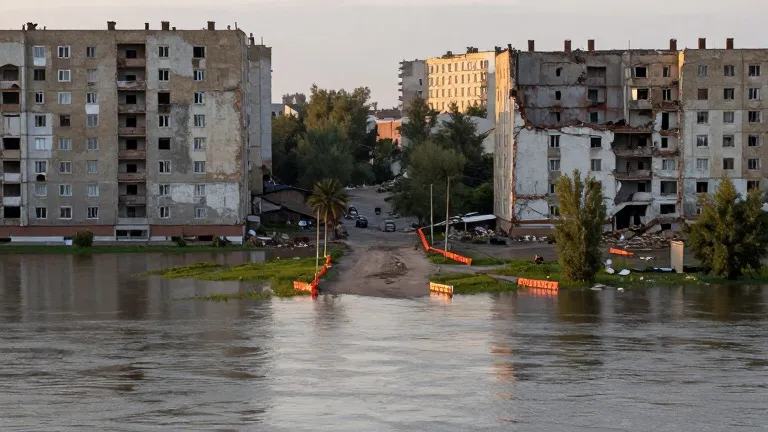
The White House confirmed on Friday that Russia and Ukraine have agreed to a temporary ceasefire in the Russian-occupied city of Oleshky. The truce is scheduled to take effect on Oct. 29. Officials stated the pause in military action is intended to allow humanitarian aid to reach residents and to facilitate civilian evacuation along a designated safe passage.
According to a White House statement, Melania Trump and her representative worked directly with Russian and Ukrainian leadership to establish the terms of the localized arrangement. The statement described Oleshky as a front-line city facing a dire situation. It noted that the remaining population consists mostly of elderly individuals who require urgent medical attention, medicine, food, and clean water.
The city sits across the Dnipro River from Kherson. The White House reported that Oleshky currently has between 1,700 and 2,000 residents, including approximately 50 children. Before the war began, the population was roughly 24,000. Officials added that about 90 per cent of the city was flooded following the destruction of the Kakhovka Dam.
Ukraine’s top negotiator, David Arakhamia, posted on Telegram that the humanitarian operation would commence once the ceasefire takes hold. He stated that the accord followed a long process involving both Melania Trump and Pope Leo. Arakhamia said the agreement would create a corridor for people to leave and for assistance to enter.
The Kremlin indicated that the evacuation process would take at least a few days. Russian President Vladimir Putin reportedly told Pope Leo by telephone last week that he was ready to co-operate on the issue. The Kremlin praised Melania Trump and said work was underway to improve conditions in Oleshky.
Russian Chief of the General Staff Valery Gerasimov announced that Russian forces will stop firing from 4 a.m. local time on Oct. 27 to support the operation. Under the deal, non-military teams from both countries will visit residents in their homes. These teams will help arrange transport for anyone who wishes to leave for either Russia or Ukraine.
Separately, Ukrainian President Volodymyr Zelenskyy said that negotiators from Ukraine, Russia, and the United States agreed to hold technical-level talks in Abu Dhabi in the first half of November. Zelenskyy told the Hudson Institute that he had spoken with U.S. envoys Jared Kushner and Steve Witkoff following their meeting with Putin earlier in the week. He stated that any peace deal would require strong security guarantees and 10 years of funding for Ukraine’s army.
The announcements come after two weeks of criticism from European allies and members of both major U.S. political parties regarding American involvement in the war. President Donald Trump had previously struck a deal with Putin to import diesel and announced a ceasefire on energy attacks, though Russia showed no sign of halting its fire. On Oct. 14, Zelenskyy said SpaceX had restricted Starlink service, a move Ukrainian officials say hampers strikes and drone defence.
Fighting continued on Friday. Moscow’s Sheremetyevo airport briefly suspended operations due to a Ukrainian drone threat. Mayor Sergei Sobyanin said air defences downed 21 drones heading for the capital over two hours. The two sides also exchanged 270 prisoners each. Ukraine’s acting prosecutor general, Anton Kovalskyi, said more than 19,000 Ukrainian civilians, including 762 children, have been killed since the full-scale invasion began.
Source: CBC News