Russia demands NATO retreat to 1997 borders in Ukraine peace talks
A document presented in Abu Dhabi seeks to reverse NATO's eastern expansion, prompting strong backlash from European leaders who view the alliance's structure as vital to their security.
By Evelyn Adeyemi ·
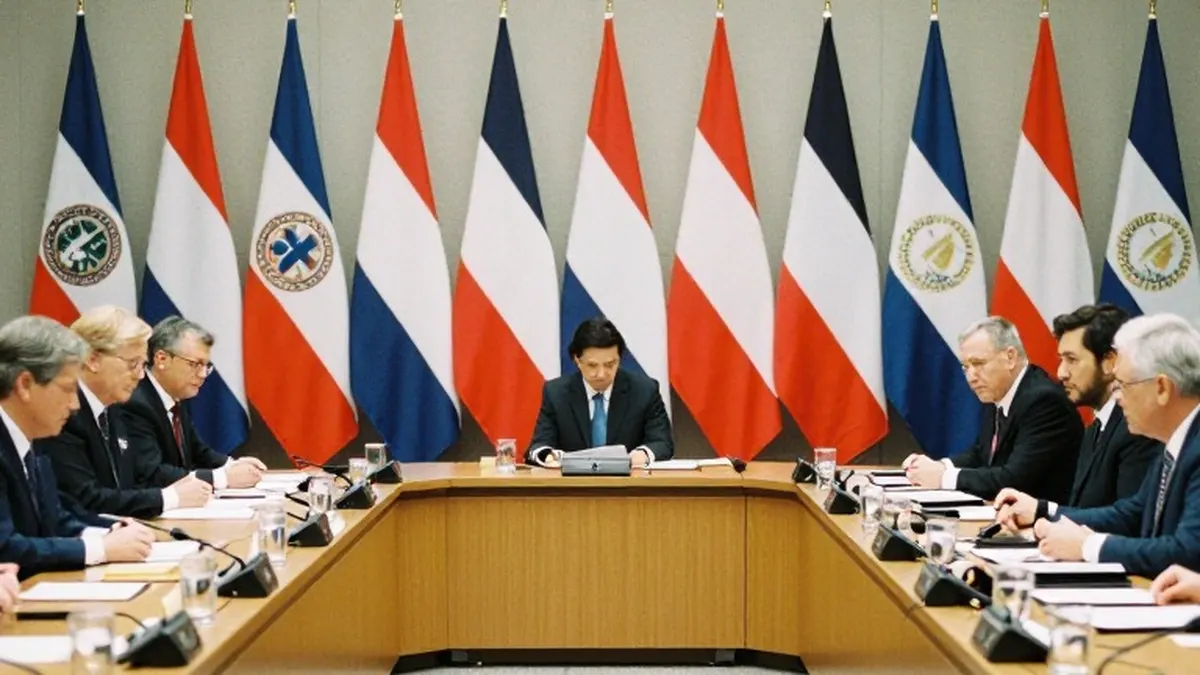
Russian representatives in Abu Dhabi have introduced a proposal for ending the war in Ukraine that includes significant demands regarding the North Atlantic Treaty Organization. According to reports from The New York Times, a document dated November 10 calls for an end to Western arms deliveries to Kyiv and requests that NATO withdraw its troops and bases. The core of the proposal is to return the alliance's military footprint to its 1997 configuration, effectively rolling back decades of eastward expansion.
The reference to 1997 marks the period before NATO's first major enlargement. At that time, the alliance consisted of 16 members. While Poland, the Czech Republic, and Hungary had been invited to join, they did not formally become members until 1999. Since then, numerous countries from Central, Eastern, and Southeastern Europe, as well as recent Scandinavian additions, have joined, bringing the total membership to 32 states across Europe and North America. Russia is not explicitly demanding that these countries leave the alliance, but rather that NATO end its military presence in their territories.
Such a withdrawal would have immediate consequences for the defense capabilities of newer members. The Baltic states, for instance, rely on NATO for air policing because they lack sufficient fighter jets for independent operations. Since 2004, allies including Germany have rotated through Estonia, Latvia, and Lithuania to provide this coverage. A withdrawal would also disrupt the planned deployment of the German Lithuania Brigade, which is expected to be fully operational by the end of 2027. Additionally, the expansion of the Mihail Kogalniceanu Air Base in Romania, set to become Europe's largest NATO air base by area, would be affected.
Leaders in Europe have reacted with skepticism to the proposal. Polish Prime Minister Donald Tusk stated that no one should establish new security rules for the region without the input of Poland and Europe. Bulgarian President Rumen Radev described the idea as unthinkable and unrealistic, arguing that external pressure should not force countries to reverse their alliance choices. Estonian Prime Minister Kristen Michal rejected any Russian influence over Europe's security order, noting that the current system is working well.
Despite the strong public rejection, there are underlying fears along the alliance's eastern flank that a deal between Washington and Moscow could use European security as a bargaining chip. The mutual defense clause, known as Article 5, obligates members to aid an attacked ally. However, for this commitment to deter an aggressor, NATO must demonstrate the ability to intervene quickly. The presence of troops on the eastern flank serves this deterrent purpose, and their removal could signal to Moscow that an attack would involve fewer risks.
The debate also centers on whether NATO ever promised not to expand eastward. While US Secretary of State James Baker and German Foreign Minister Hans-Dietrich Genscher used language suggesting limits during German reunification talks in 1990, no legally binding general promise was made regarding other former Warsaw Pact countries. The 1997 NATO-Russia Founding Act explicitly stated that neither side had a veto over the other's decisions. Furthermore, the 1994 Budapest Memorandum, which assured Ukraine of its borders in exchange for giving up nuclear weapons, did not obligate the US or UK to defend Ukraine militarily.
The demand for a security freeze is not new. Just over two months before the full-scale invasion of Ukraine, the Kremlin presented draft treaties to the US and NATO demanding an end to further enlargement. These drafts proposed that Russia and NATO members present as of May 27, 1997, refrain from deploying additional troops or weapons beyond those levels. Russia maintains that NATO enlargement is a root cause of the war and seeks to address these issues as part of a postwar security framework.
So far, major Western players have shown little willingness to accept the Abu Dhabi demands. Stanislaw Zaryn, a former Polish intelligence coordinator, viewed the talks as an attempt by Russia to buy time and weaken the West ahead of a future confrontation. As negotiations continue, the tension between Moscow's desire for a smaller NATO and Europe's reliance on the alliance for security remains a central challenge in ending the conflict.