NASA's Voyager 1 to Set Record as First Object to Travel One Light-Day From Earth
The veteran NASA probe, launched in 1977, is expected to pass the 16 billion mile mark on Wednesday, becoming humanity's first object to reach a distance of one light-day from Earth.
By Lorenzo Evans ·
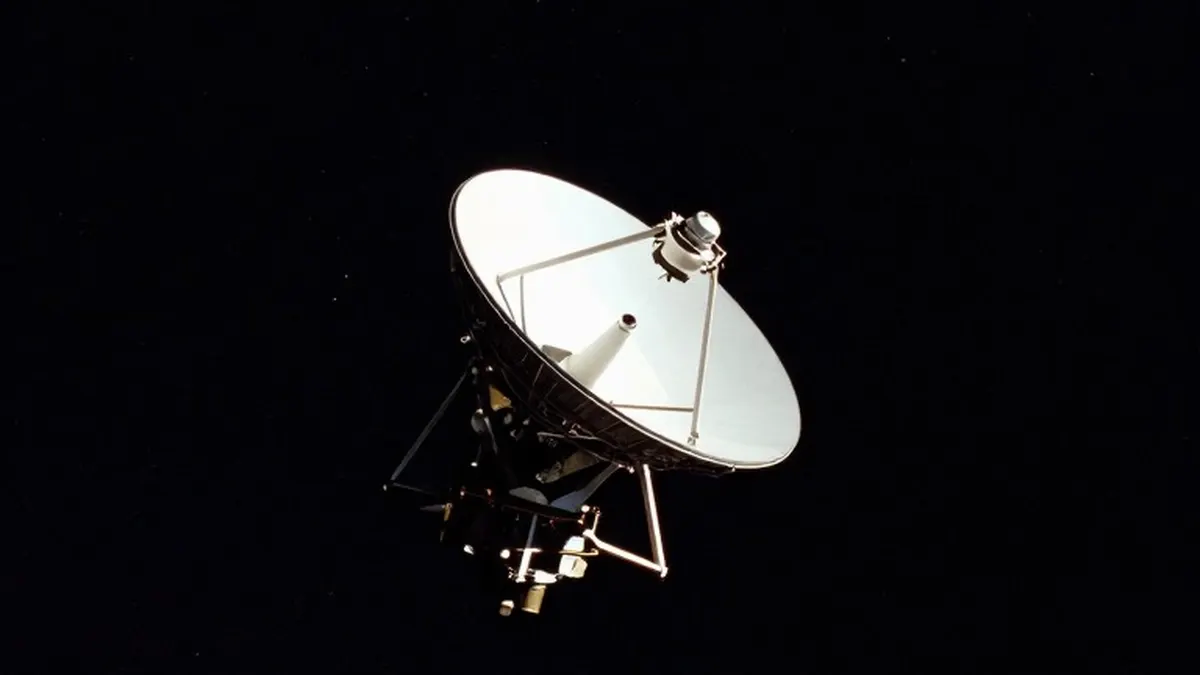
NASA has announced that its Voyager 1 probe will soon become the first object made by humanity to travel one light-day from Earth, a new distance record for a spacecraft that has been flying since 1977.
On Wednesday, the robotic space probe is set to pass the milestone of travelling at least 16 billion miles since its launch. That distance is equal to one light-day, or how far light can travel in 24 hours.
Voyager 1 completed its Saturn flyby in 1980, which marked the end of its primary planetary mission. The probe is currently travelling at roughly 36,000 miles per hour in interstellar space, the vast gap between stars.
Even at that pace, NASA expects it will take the spacecraft some 18,000 years to travel a full light-year, and double that amount of time before it nears another star, a reminder of just how enormous the distances between stars really are.
Voyager 1, which is powered by plutonium, was launched shortly before its twin probe, Voyager 2. Both spacecraft continue to relay data back to Earth on a daily basis, including readings on the strength and direction of the magnetic field around them, as well as measurements of the surrounding pressure, dust and galactic cosmic rays. Voyager 2 is expected to hit one light-day from Earth in 2035.
Both probes are kept active by a skeleton team of NASA engineers, who send commands roughly once a week, and more often when a spacecraft runs into trouble. In October, the team briefly lost communication with Voyager 1, and the cause of that interruption has not yet been determined.
Suzanne Dodd, the project manager for Voyager 1, has described the spacecraft as "a national treasure." She told The Associated Press news agency that the two probes' day to day activities are akin to those of weather satellites.
The probe's cultural impact has been significant as well. In 1990, Voyager 1 captured the famous "Pale Blue Dot" photograph of Earth.
The Planetary Society's Bill Nye underscored the missions' reach in a statement, saying that everyone on Earth has been touched by them.
For now, Voyager 1 continues its journey outward, still sending data home from the space between the stars.