Gaza's deaf and visually impaired children lose access to schooling amid war devastation
Children with hearing and visual impairments in Gaza have seen their specialised schools destroyed and essential supplies cut off, leaving a generation at risk of losing hard-won skills.
By Worldwide Herald Staff ·
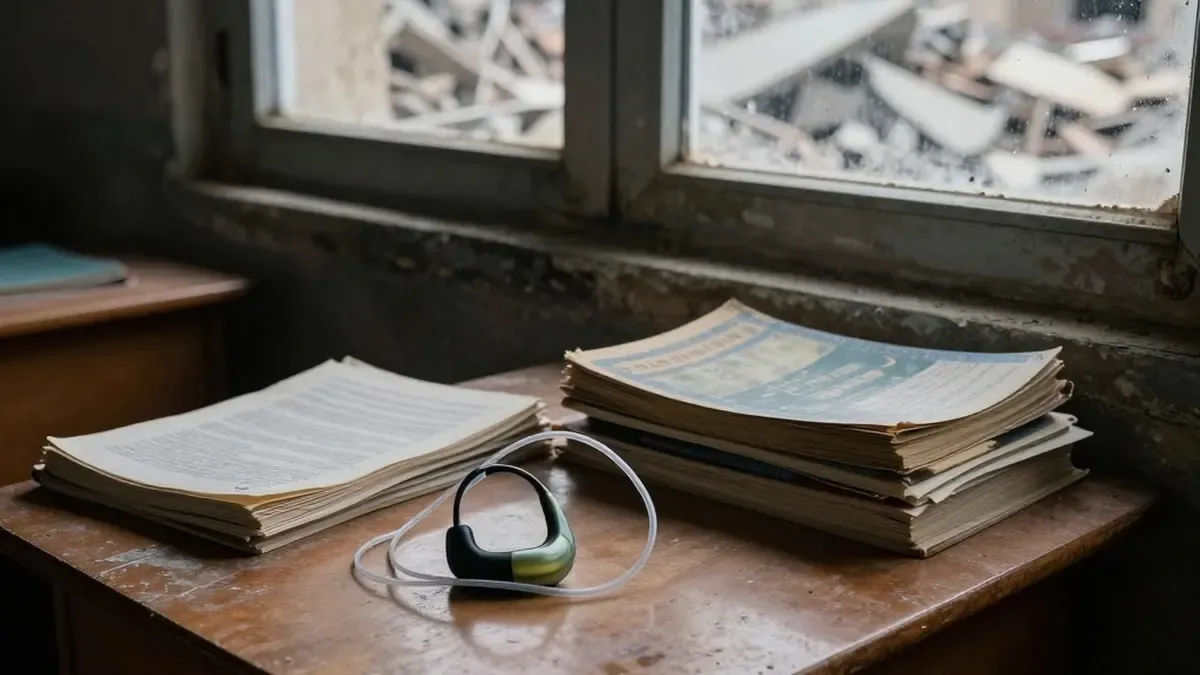
Thirteen-year-old Kenan al-Sabaa needs new plastic tubing and a rubber ear mould for his malfunctioning hearing aid, but those parts, along with replacement batteries, are no longer available because of Israel's siege on the Gaza Strip. Before the war began in October 2023, Kenan attended the Atfaluna Society for Deaf Children in Gaza City, which offered specialist teaching and contact with other hearing-impaired children.
Atfaluna's building was partially levelled during the war and turned into an overcrowded shelter for displaced people, part of the widespread destruction of infrastructure that includes the educational institutions disabled children depend on. Kenan's family was forced to flee to Gaza City's Jalaa Street. Atfaluna has since opened temporary learning spaces, including one near the family's new home, but his father, Tamer al-Sabaa, says the disruption has left his son far behind. Kenan missed school entirely during the first year of the war and now attends classes only a few hours a week.
"These few hours do not cover or repair the massive educational gap and academic decline my son experienced during the war," Tamer said. "He is in dire need of restoring his equipped educational environment and the specialised care that was stripped away from him." He said the school operates only three days a week, for no more than two hours a day. Tamer also fears that if large-scale Israeli attacks resume, he will have to stop Kenan from attending. An October 2025 ceasefire reduced the attacks but did not end them.
Kenan's deafness makes moving around dangerous, since he cannot hear explosions or warning signals. His parents guided him through unfamiliar neighbourhoods until he learned to reach school on his own, though his safety remains a constant worry.
Kenan's difficulties reflect the broader toll of the war, which has killed more than 74,000 Palestinians, on disabled children in the enclave. Fadel Kuraz, a sign language interpreter and disability rights advocate with Atfaluna, said about 20,000 people with hearing disabilities were registered in Gaza before October 2023, while field assessments indicate roughly 35,000 more have since suffered total or partial hearing loss from explosions. He described shortages of hearing aids, batteries, ear moulds and spare parts, along with obstacles to hearing tests and difficulties accessing visual learning materials because of electricity and communications outages.
"A deaf child suffers high levels of fear, stress and complex trauma without the ability to verbally express what is on their mind," Kuraz said. Many hearing-impaired children live in overcrowded tents or shelters without space to study. He called for urgent intervention to break the siege, allow in hearing devices and spare parts, and establish safe temporary educational spaces.
Visually impaired children face similar problems. The al-Noor school in Tal al-Hawa, southwest of Gaza City, was the only public school in Gaza for middle and high school students with visual impairments, serving about 80 pupils, many brought in on dedicated buses. Badly damaged in the war, it was forced to close, though some primary education remains available through centres run by UNRWA, the United Nations agency for Palestinian refugees. Braille materials are also hard to obtain under the siege. Duaa Omar Basheer, an educational counsellor at the school before the war, warned that without regular instruction students could lose Braille and independent-learning skills built over years. "We are facing an entire generation of visually-impaired individuals at risk of illiteracy and academic loss," she said.
In the Shati refugee camp, Wafaa Shreim's 12-year-old daughter Jana, who is legally blind, relied on prescription glasses with very strong lenses and could perceive only light, shapes and nearby objects. Her glasses broke during the mass flight from the camp amid Israel's November 2023 offensive, and the family could not repair the damaged lenses or afford replacements. Her vision has since deteriorated so badly that she stumbles in unfamiliar places, is bullied by other children and feels pain when she tries to focus.
"My daughter now has to identify people by their voices," Wafaa said. "Her sister and I now act as her 'eyes' at every step and everywhere she goes." With Jana's school closed, Wafaa teaches her at home with a Braille writing machine while also caring for another visually impaired daughter. She said appeals to many organisations yielded nothing: "we have been left entirely alone." Her plea to responsible parties was simple: provide glasses and medical supplies, and open safe educational and recreational spaces to restore children's basic right to learning.
Source: Al Jazeera