AI model reveals hidden mathematical proofs in Kurt Gödel's obscure notebooks
A Finnish logician used an AI assistant to decipher thousands of pages of Kurt Gödel's shorthand notes, uncovering hundreds of previously unknown theorems and near-complete proofs.
By Khalid Khalil ·
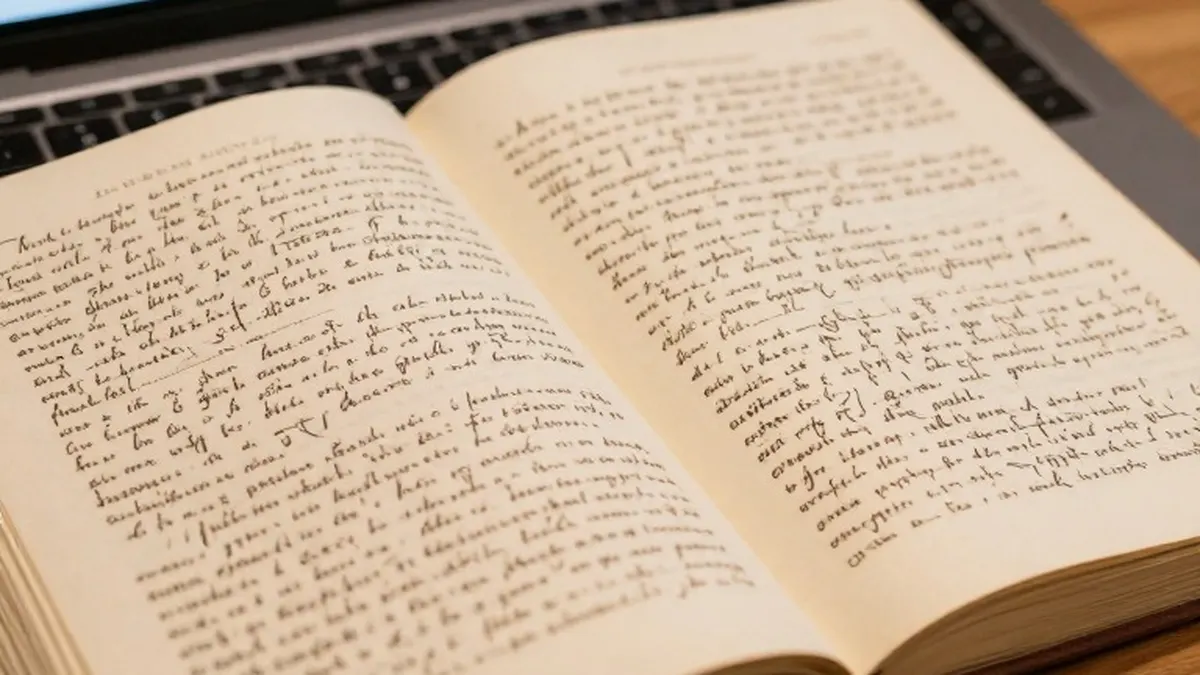
Kurt Gödel, the Austrian logician whose 1931 incompleteness theorems reshaped mathematics and laid the groundwork for the digital age, left behind a vast archive of unpublished work. While he published only a handful of papers after his initial breakthroughs, his handwritten notes span tens of thousands of pages. Since 2017, Jan von Plato, a logician at the University of Helsinki, has led a project to decode 16 notebooks written in the early 1940s. These documents, totaling 1,009 pages, are written in Gabelsberger, a German shorthand system that had already become obsolete by the time Gödel used it.
For years, progress on the project was slow, with von Plato and his team managing to interpret only about one page per week. The breakthrough arrived in September 2026 when von Plato enlisted the help of Claude, an AI model. Within days, the AI provided a comprehensive analysis of the entire collection. This rapid processing revealed that Gödel had proven hundreds of theorems that historians were previously unaware of, suggesting the mathematician had discovered significantly more than the academic community had realized.
Von Plato expressed his astonishment at the findings, noting that the notebooks contain anticipations of results that would not be known until the 1970s and 1980s. The documents also outline 14 distinct themes in logic that have not been explored since. The logician described Gödel as being far ahead of his time, a view supported by the fact that his work inspired Alan Turing to write his foundational 1936 paper on modern computation.
The project began in 2017 when von Plato, facing mandatory retirement, sought a way to make his work indispensable. He received a 2.5 million euro grant from the European Research Council and taught himself to read Gabelsberger shorthand, a skill he claims only five other people possess. In August 2026, after meeting computer scientists at a conference in France, he decided to use AI to assist with the transcription. He fed the AI his transcriptions of the notebooks, along with six of his own books on Gödel and other secondary literature.
The AI generated a 650-page explanation of the workbooks in just a few days. Von Plato noted that while humans struggle to keep track of details across thousands of pages, the AI could connect all the pieces as a single coherent whole. One of the primary tasks was to determine if Gödel had actually proven the independence of the axiom of choice, a result for which the American mathematician Paul Cohen received the Fields Medal in 1966. Gödel had claimed in 1966 that he had already proven this result in the 1940s, but he was unable to reconstruct the proof when challenged by his peers.
The AI indicated that Gödel was very close to the correct solution. He had one definition wrong in the notebook, but he had written the correct definition two years earlier. Von Plato believes that if Gödel had continued working for a few more months, he would have arrived at the correct proof. The architecture of the proof found in the notes is considered elegant, as it allows various results in set theory to follow a uniform pattern. Von Plato ran the reconstructed proof through Coq, a program that verifies mathematical proofs, and it passed validation.
In further analysis, the AI extracted 663 theorems from the workbooks for which Gödel had proofs, proof sketches, or ideas for proofs. When these were tested in Coq, about 400 were verified as stated, and about 200 were repaired after minor adjustments to their statements or assumptions. Approximately fifty were found to be false, a result von Plato notes is not surprising given that Gödel himself often marked his own notes with marginal comments such as 'falsch' or 'schlecht', meaning bad.
Joel David Hamkins, a professor of logic at the University of Notre Dame, has not yet seen the AI's reconstruction of the axiom of choice proof. However, he stated that if the proof stands up to scrutiny, it is remarkable and historically interesting. He noted that while the presence of ideas resembling Cohen’s proof does not mean Gödel had the final version, it shows he was on the right path. Hamkins added that given the number of groundbreaking ideas in Gödel's life, it is not surprising that his private notebooks are filled with exciting discoveries.
Von Plato plans to continue exploring the manuscripts, noting that the workbooks contain more than a dozen themes in logic and the foundations of mathematics that have remained undiscovered for over 80 years. He also intends to begin exploring Gödel's notebooks on physics and cosmology once his current logic projects are completed. The ongoing study of these documents promises to reveal further treasures from one of the 20th century's most original thinkers.