5-year veteran teaches Lake Osborne anglers the art of the black crappie
A Naperville resident demonstrated how to catch the silvery-green panfish in the city's reservoir, a practice that has expanded the local fishing roster.
By Lorenzo Evans ·
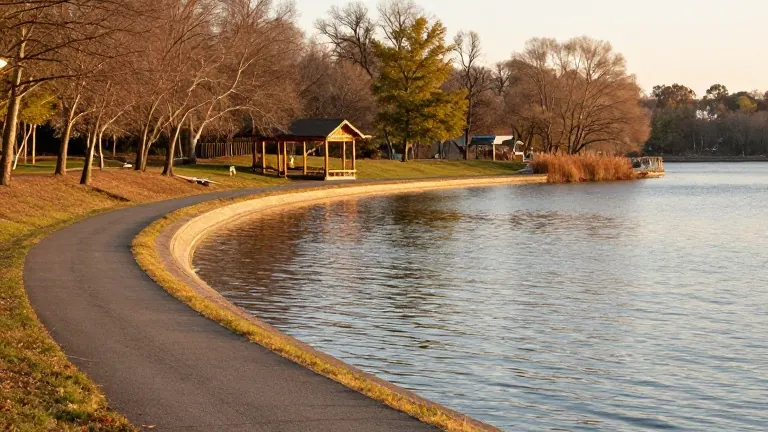
Lake Osborne, a water feature situated along Aurora Avenue just west of the Naperville Public Safety Center, serves as a local hub for recreation and angling. The site is named after Marjorie Osborne, a civic leader who advocated for water resource management in Naperville during the 1970s.
On a sunny Saturday in late November, Jason Jackson, a Naperville resident, demonstrated fishing techniques to a group of walkers. Jackson has visited the reservoir for approximately five years, initially discovering the site while traveling to a bowling alley now known as Lucky Strike. The encounter provided a lesson in catching black crappies, a species that shoreline fishermen had rarely reported despite common catches of bass, catfish, blue gill, and carp.
Jackson began by casting his line from the bank near the pavilion, an area where he initially found no success. He then moved to the opposite side of the reservoir, where he quickly caught two small black crappies. He used plastic lures attached to jigheads, a rig designed to attract the fish. By repeatedly casting and retrieving the line, he created a motion that mimicked live bait, a technique he explained to the onlookers.
The angler pointed out a specific section of the lake where he typically catches larger specimens. He described the black crappie as a North American freshwater panfish in the sunfish family. The fish is characterized by a silvery-green body covered in irregular black spots and blotches. Although the species appears on menus at various seafood restaurants, Jackson noted that its presence in Lake Osborne is a known fact among local anglers, though not always apparent to casual visitors.
All fishing at Lake Osborne operates under a catch and release policy. The lake is accessed by a paved trail that is slightly longer than a half mile. The path allows for walking and cycling, with a route that begins at the pavilion, heads east toward the Public Safety Center, and loops around to the other side. The trail winds up and down around the water feature before returning to the starting point.
Marjorie Osborne’s local leadership extended beyond water management. In June 1972, a referendum dissolved Elementary District 78 and High School District 107, creating the 32-square-mile Community Unit School District 203. Osborne was elected on August 12, 1972, to serve the new district alongside Daniel Butler, Mary Lou Cowlishaw, John Dahlberg, Dean Davis, Wilma Reschke, and Andrew Wehrli. In the mid to late 1980s, she served as president of the local preservation society and had previously been a member of the Naperville Plan Commission.
The lake supports a variety of wildlife, including waterfowl and native birds. A house built specifically for purple martins stands nearby, though the birds do not always visit. The area is also a viewing spot for sunsets, particularly from a bench near Oswego Road facing west. Early evening reflections on the water draw residents who use the space to step away from daily routines.
The pavilion at Lake Osborne has hosted picnics since 1994. The shoreline continues to welcome anglers who utilize the catch and release system. The paved trail remains open for brisk walks and bicycle rides, connecting the pavilion to the Public Safety Center and the surrounding neighborhoods. The site remains a point of reference for both recreational activities and local history.